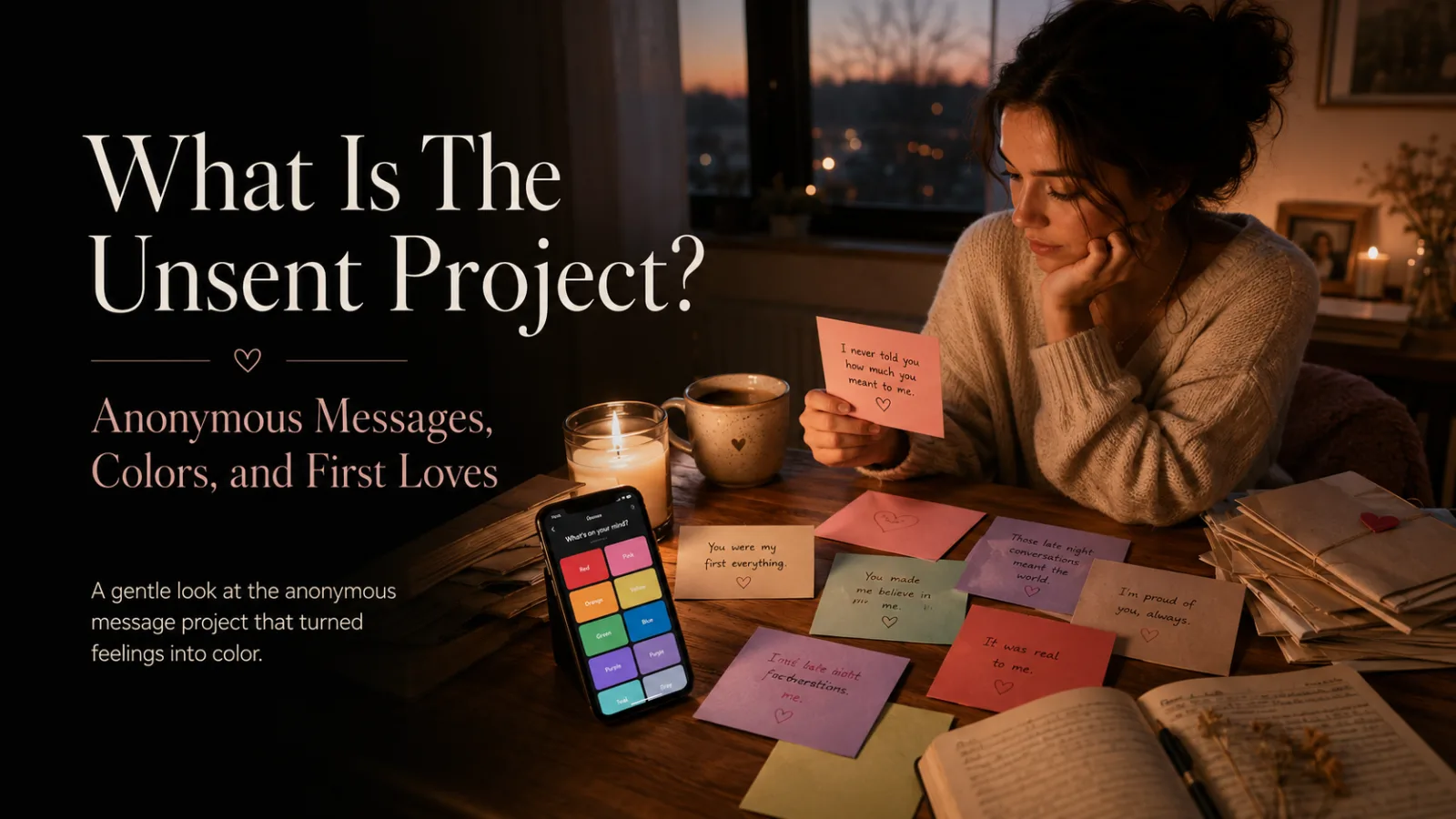
The Unsent Project is an online collection of anonymous text messages written to people’s first loves.
Artist Rora Blue started the project in 2015 with a question: what color do people associate with love? Contributors wrote messages they had never sent to a first love and chose a color connected to that person or memory. Those submissions became part of a searchable visual archive.
The idea was simple, original, and easy to understand.
Write the message you never sent. Choose the color that reminds you of the person. Add it anonymously to a collection of millions of other messages.
The official site now describes The Unsent Project as an archive of more than five million anonymous messages submitted by people around the world.
That number says something larger than any one message could. Millions of people have opened a blank box and written words they couldn’t place in the hands of the person they were meant for.
How does The Unsent Project work?
Visitors can do two main things: submit a message or search the existing archive.
A submission is addressed to a first love. The writer enters the person’s name, writes the message, and connects it with a color.
A message might say:
I still compare every quiet Sunday morning to the ones I spent with you.
Another might be blunt:
You taught me what love felt like and what I would never accept again.
Once accepted into the archive, the message joins other anonymous submissions rather than appearing as part of a personal profile.
Readers often search a first name to see what strangers have written to people with that name. Searching for “Alex,” “Emily,” or “Michael” can return many unrelated messages from different writers, relationships, countries, and years. The official archive invites visitors to search by name or read submissions directly.
The appeal is obvious. Someone searches their own name and wonders whether one of the messages could be about them.
Usually, there is no way to know.
Who created The Unsent Project?
Rora Blue created The Unsent Project as an art project in 2015.
The original question centered on the color people associate with love. Each participant selected a color connected to their first love, and the message appeared against that color. Over time, the collection grew into a large record of affection, heartbreak, anger, regret, gratitude, and unfinished relationships.
The color system gave the project an identity beyond anonymous confession.
A black message may carry grief, anger, distance, or finality. Pink may remind someone of tenderness or young love. Blue may represent calm for one writer and sadness for another.
The project doesn’t need every color to have one official meaning. The person submitting the message decides what the color means to them.
Why is The Unsent Project about first loves?
First love is the project’s original frame.
That doesn’t always mean the first person someone dated. A first love might be the first person who made the writer feel chosen, the first relationship that felt serious, or the person who shaped how the writer understood love afterward.
First loves stay memorable because so much is unfamiliar when the relationship begins.
The writer may be learning how attachment feels, how jealousy works, how badly rejection can hurt, or how quickly another person can become part of daily life. Even when the relationship lasts only a few months, the memory may outlive relationships that lasted longer.
The messages often carry the perspective of someone looking backward:
I thought loving you meant we would always find our way back. I know better now, but part of me still remembers believing it.
Other writers address the person from inside the loss:
You stopped replying three weeks ago, and I’m still pretending I haven’t noticed.
The first-love focus gives The Unsent Project a clear artistic boundary. It also leaves many kinds of unsent writing outside that boundary.
Why do people search names on The Unsent Project?
Some are curious. Others are hoping.
A person may search their own name after a breakup and wonder whether an ex submitted something. They may search the name of someone they love, looking for a message that resembles their story. Others search common names simply to read what strangers were unable to say.
The uncertainty is part of the experience.
A message might mention a familiar song, city, nickname, or breakup. The reader starts building a connection between the anonymous words and someone they know.
But shared feelings produce similar language.
Millions of people have missed an ex, regretted an argument, remembered a first kiss, or wished they had said goodbye differently. A familiar sentence isn’t proof that the message was written for you.
The healthiest way to read the archive is as a collection of human experiences, not a secret inbox where you’re guaranteed to find a confession addressed to you.
Are the messages really anonymous?
The public messages don’t identify their writers through a visible personal profile.
Still, anonymity depends partly on what a person writes.
A message can reveal a writer through an unusual memory, private nickname, exact date, workplace, school, or detail only two people would know. Even when a legal name isn’t attached, the recipient may recognize the event.
Anyone submitting personal writing to a public archive should assume that the words may be read, saved, copied, or recognized.
Remove details that could expose you or another person. Don’t include phone numbers, addresses, social media handles, workplaces, private medical information, or claims meant to damage someone publicly.
Anonymous should mean protected, not careless.
Is The Unsent Project the same as Unsent Letters Wall?
No. They are separate websites created by different people, with different formats and purposes.
The Unsent Project is Rora Blue’s color-based collection of short anonymous messages to first loves. Unsent Letters Wall is an independently founded and moderated public wall created by Dennis and Becca for longer letters and a wider range of recipients.
There is no affiliation between the two.
We respect what The Unsent Project built. It proved that people would show up by the millions to write the message they couldn’t send and read what strangers had kept inside.
It also helped reveal how much more could be built around that human need.
We wanted a place where the writer wasn’t limited to a first love or a short message. Some experiences need three sentences. Others need three pages.
A grieving wife may want to write to her husband.
An adult son may have words for an absent father.
Someone may need to address the friend who betrayed them, the child they lost contact with, a younger version of themselves, or a person whose name they still can’t bear to type.
Those writers needed more room.
Why we created Unsent Letters Wall
We wanted to build something better for people who needed a full letter rather than a short anonymous confession.
“Better” doesn’t mean copying The Unsent Project and changing the design. It means building around needs its first-love format was never intended to meet.
Unsent Letters Wall accepts writing to:
Someone the writer still loves
Someone who hurt them
Someone who died
An ex
A parent
A former friend
A younger self
A future self
The writer’s present self
Someone whose name they can’t say
A recipient who doesn’t fit an existing label
The public wall is moderated, and letters can be published anonymously. A writer doesn’t need an account to begin. The submission form also allows the writer to choose whether the letter should enter public moderation or remain private.
The length matters too.
A short message can capture a sharp feeling:
I still look for your car when I pass your street.
A letter can explain why that street still matters:
I still look for your car when I pass your street. I know you moved two years ago, but my mind hasn’t updated the picture. For a second, I’m back in the year when I could turn into your driveway and believe I was welcome.
Both forms have value. We built the wall for writers who need the second one.
What makes Unsent Letters Wall different?
The first difference is scope.
Love and breakups belong on the wall, but they aren’t the whole wall. Grief, family estrangement, friendship loss, apology, anger, self-forgiveness, regret, and things left unsaid belong there too.
The second difference is the letter format.
Writers can create a title, address a recipient, choose a category, and give the experience enough space. A full letter lets a person describe what happened, what changed, and why the words remained unsent.
The third difference is moderation.
A public writing site needs boundaries. Names, threats, harassment, identifying details, and content meant to punish another person can turn personal expression into harm. Unsent Letters Wall reviews public submissions rather than treating anonymity as permission to publish anything. The site describes itself as a moderated public wall shaped around privacy, honest writing, and reader safety.
The final difference is what comes after the first letter.
Some writers need only one public release. Others realize they need a quiet place to keep writing.
That is why Unsent Letters Wall connects naturally with Unsently.com.
Where does Unsently.com fit?
Unsently is the deeper, private writing and community side of what we’re building.
The wall is public-facing. A person can leave one letter, read what others have written, and walk away without creating an account.
Unsently gives members room to continue.
It supports private writing, optional anonymous sharing, unsent texts, handwritten notes, prompts, profiles, reactions, comments, community conversations, and a Release Room. The service describes itself as a quieter place for letters, texts, and thoughts people don’t send but still need to write.
The connection between the two sites is intentional:
Unsent Letters Wall is the public doorway.
Unsently is the private space for ongoing writing, reflection, and connection.
Someone may arrive after searching for The Unsent Project because they want to see whether an ex wrote their name. Then they may realize what they really need is to write their own letter.
They can place that letter on the wall.
If one letter becomes several, or if the writing feels too private for a public collection, Unsently gives it somewhere else to go.
Is Unsent Letters Wall trying to replace The Unsent Project?
No.
The internet has room for more than one form of unsent writing.
The Unsent Project has a clear artistic identity: anonymous, color-coded messages to first loves. Its scale and staying power show that the idea connected with people across the world.
Unsent Letters Wall serves a broader purpose.
We aren’t asking only, “What would you say to your first love?”
We’re also asking:
What would you say to your mother if you knew she wouldn’t interrupt?
What would you tell the friend who disappeared?
What ordinary detail would you share with the person who died?
What apology have you rehearsed but never earned the right to deliver?
What does your younger self still need to hear?
Those questions don’t fit neatly inside a short text addressed to a first love. They require another kind of space.
Can you submit the same message to both sites?
You should review the terms of each site before submitting the same work in more than one place.
The format may also make the decision for you.
A brief message to a first love may fit The Unsent Project well:
I hope someone loves the parts of you I spent years trying to reach.
A longer account involving grief, family, betrayal, apology, or personal change will probably fit Unsent Letters Wall better.
You don’t need to stretch a three-line thought into a full letter. You also shouldn’t cut a meaningful story down until only a clever sentence remains.
Choose the form that lets you say what you intended to say.
Can you search for a specific person on Unsent Letters Wall?
Unsent Letters Wall isn’t designed as a service for finding secret messages addressed to your name.
Its public wall is organized around letters, recipients, categories, and human experiences. Readers can explore writing about former partners, parents, grief, friendship, hurt, love, and other subjects without assuming a letter belongs to them.
That difference matters.
Searching your name can be entertaining, but it can also keep you attached to guesses. People begin reading every familiar phrase as evidence that someone still loves them, regrets leaving, or wants to return.
A letter wall works best when readers meet the words as they are: one person’s attempt to express something they couldn’t deliver.
For anyone who wants to understand why these messages carry so much weight, our article about the texts and drafts people never send looks at the feelings behind them without turning anonymous writing into a guessing game.
Is The Unsent Project safe to use?
The official site requires visitors to confirm that they are at least 18 and warns that the archive may contain explicit content.
Writers should still make their own privacy decisions before submitting.
Don’t include a person’s full name alongside details that identify them. Don’t use an anonymous archive to threaten, expose, or shame someone. Don’t submit something because you hope strangers will help you punish the recipient.
Readers should take care too.
An anonymous message may touch a raw part of your own story. It may also tempt you to believe you’ve found a message from someone you know. Step back when the archive begins feeding obsession rather than curiosity.
A public collection can hold honest emotion. It can’t tell you who wrote a message, whether every claim is accurate, or what you should do about your own relationship.
What should you write in your own unsent letter?
Start with the person you’re addressing and the sentence you’ve avoided.
You may begin with:
I thought I had more time to say this.
I’m writing because contacting you would be a mistake.
You’ll never know how often I almost called.
I still don’t understand why you chose silence.
I owe you an apology without asking you to forgive me.
Then get specific.
Name the phone call, the empty chair, the missed birthday, the joke you still remember, or the moment trust changed. A real detail carries more weight than ten declarations about being heartbroken.
The letter can remain private. It can be destroyed. It can be rewritten into a message you decide to send. It can also be shared publicly after names and identifying details have been removed.
Our guide toposting an unsent letter anonymously explains how to prepare a private draft before placing it on a public wall.
Where should you share your message?
Use The Unsent Project when you want to contribute a short, color-linked message to a first love within Rora Blue’s established art project.
Use Unsent Letters Wall when you need room for a letter, want a category beyond first love, or prefer a moderated wall built around many kinds of unfinished communication.
Use Unsently when the writing is private, ongoing, or part of a longer personal practice.
A person may use only one of these spaces. Another may read one, publish on another, and keep their most personal work somewhere private.
The right choice depends on the words you’re carrying and who, if anyone, should be allowed to read them.