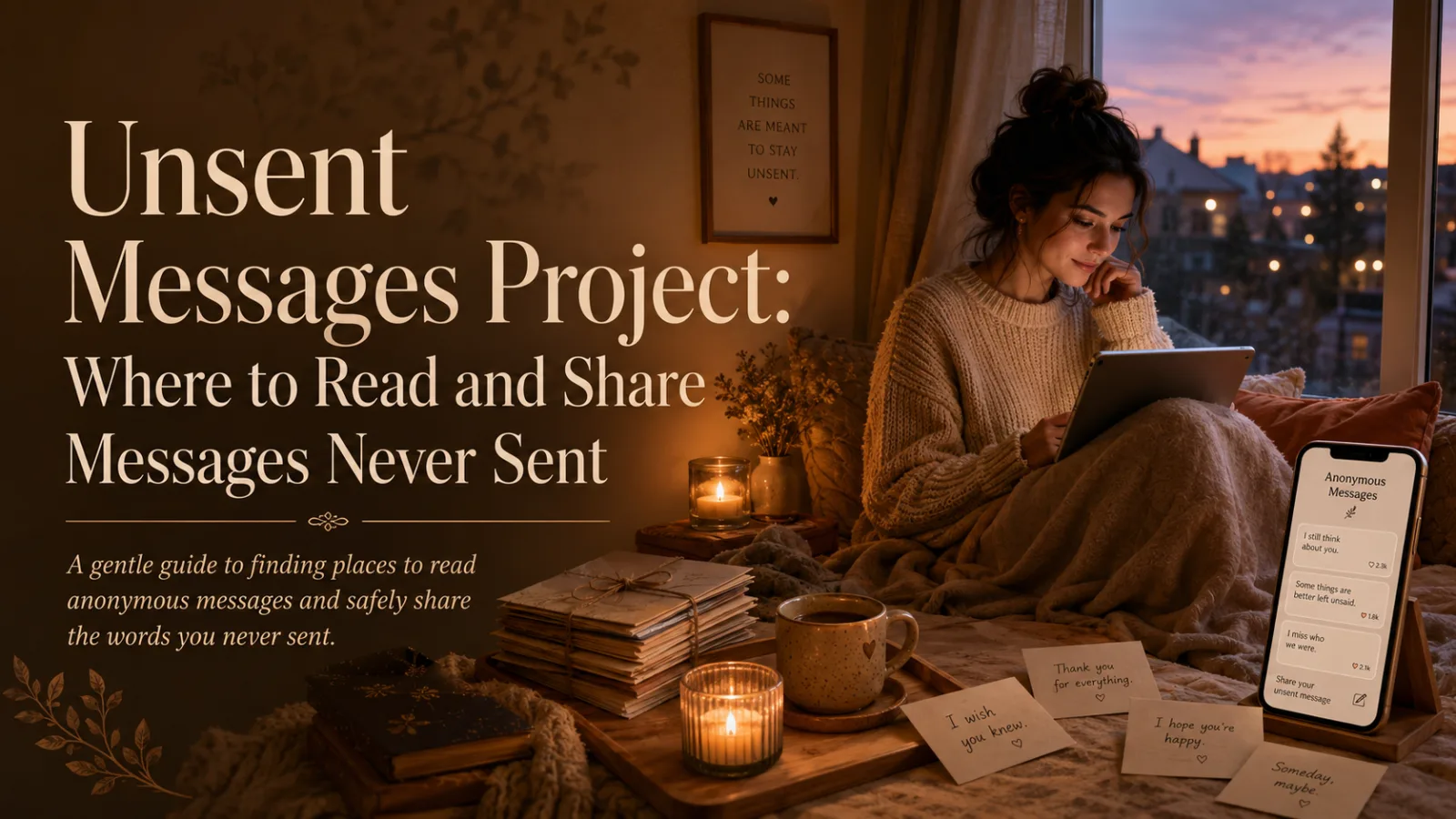
An unsent messages project is a collection of texts, DMs, notes, and short messages written to real people but never delivered.
The messages may be romantic, angry, apologetic, grieving, or impossible to categorize. One may contain a single sentence written after a breakup. Another may be the draft of an email someone has kept for five years.
Some projects collect messages to first loves. Others accept writing to parents, friends, former partners, people who died, and people the writer can’t safely contact.
The best collections don’t treat these messages as entertainment alone. They give readers a glimpse of what people say when the recipient is absent and the usual social rules fall away.
What is an unsent messages project?
It is a public or private collection built from messages that were written but withheld.
A personal project may live in a phone note or private folder. A writer might copy every text they almost sent to an ex and save it somewhere outside the active message thread.
A public project invites submissions from strangers. Messages are reviewed, published anonymously, and arranged by recipient, subject, color, category, or date.
The format usually favors short writing:
I still look for your name when my phone lights up.
I’m sorry I made you carry the consequences of my choices.
Your birthday passed, and I didn’t know what to do with the whole day.
I wish I had believed you the first time.
These messages don’t explain the entire relationship. They catch one part of it clearly enough that a stranger can feel what sits behind the sentence.
Why are unsent messages so popular?
Short messages feel immediate.
A full letter often sounds considered. It may explain the history, name several events, and arrive at a conclusion.
An unsent text can sound like the exact moment before someone pressed delete.
That closeness attracts readers.
The person reading may not know who the writer is, how old they are, or what happened before the message. The missing context leaves room for recognition.
A reader sees:
You were the first person I wanted to tell.
They may think of a deceased parent, an ex, a former best friend, or someone who slowly became a stranger.
The same sentence can belong to many different losses.
Are unsent messages always about love?
No.
Romantic messages receive a great deal of attention because longing, rejection, and first love fit the format well. They are far from the only reason people write something and stop before sending it.
An unsent message may be addressed to:
A parent who was emotionally absent
A friend who broke the writer’s trust
A sibling after a family argument
A former coworker
Someone who died
A person the writer hurt
An adult child who ended contact
A younger version of the writer
Someone they never had the courage to approach
A grieving message may read:
Mom, I got the promotion. I hated that everyone congratulated me except the one person I wanted to hear.
A friendship message may be quieter:
I miss telling you things more than I miss the friendship we actually had at the end.
The subject changes. The unfinished communication remains.
The difference between an unsent message and an unsent letter
Length is the clearest difference, but it isn’t the only one.
A message often comes from impulse. It may be typed quickly after seeing a photograph, hearing a song, receiving bad news, or remembering an argument.
A letter usually gives the writer more time to examine what happened.
Compare the message:
I wish you had chosen me.
with the letter version:
I spent years believing you were confused, afraid, or waiting for the right time. I can admit now that you made a choice. It simply wasn’t the one I wanted.
Both express rejection. The longer version allows the writer to name the belief that kept them waiting.
Some people need one sentence. Others discover that the sentence is only the entrance to a much larger story.
That is why a collection of full unsent letters written to many kinds of people serves a different purpose from an archive built mainly around short messages.
What is The Unsent Project?
The Unsent Project is the best-known example of an anonymous messages project.
Artist Rora Blue created it around messages people never sent to their first loves. Writers submit a short message, address it to a name, and connect it with a color they associate with that person or relationship.
Its popularity helped make phrases such as “unsent project,” “unsent message project,” and “messages never sent” familiar to a much larger audience.
Many visitors search names inside the archive, hoping to find something that sounds as though it was written for them. The messages are anonymous, so a familiar sentence or memory doesn’t prove who wrote it.
The project’s first-love focus also gives it a specific boundary. A person writing to a deceased spouse, estranged parent, former friend, or younger self may need another kind of collection.
Our guide to The Unsent Project, its color system, and its focus on first loves explains that difference in greater detail.
Why people search for messages addressed to their name
Hope is usually part of it.
Someone may search their own name after a breakup, wondering whether an ex still thinks about them. They may search the name of a first love and imagine one of the messages belongs to their relationship.
The experience can be harmless curiosity. It can also become a cycle.
A reader finds a sentence that resembles something their ex once said. Then they search more names, colors, phrases, and memories. The anonymous archive starts functioning like a puzzle they believe they can solve.
Common experiences create common language.
Many people remember a song from the car. Many people regret a final argument. Many people still know an old phone number. A familiar detail may feel personal without being connected to your life.
Read anonymous messages for what they reveal about people generally. Don’t treat them as proof that someone from your past is trying to reach you indirectly.
Why people share messages they never sent
Some writers want to be witnessed without reopening contact.
They may know that sending the message would violate no contact, restart an argument, or place pressure on someone who has moved on.
Public anonymity offers a middle ground.
The writer can say:
I still love you, but I know love isn’t a reason to interrupt your life.
The recipient doesn’t have to receive the message. The writer still knows another person may read it and understand.
Other writers share because the message feels too personal to keep but too brief to become a full letter.
A few lines can hold the entire point:
You apologized for leaving. You never apologized for what you did before you left.
The short form gives the thought a clean edge.
Should you send the message to the person instead?
Sometimes, but don’t confuse the need to write with the need to deliver.
The first draft may exist only because the emotion needed somewhere to go.
A message sent to another person creates a new event. They may respond, ignore it, misunderstand it, share it, or ask the writer not to contact them again.
Before sending, identify the actual purpose.
A boundary message may be appropriate:
Please don’t contact me through my family again.
A practical message may be necessary:
I left your documents with the front desk. You can collect them after 4 p.m.
An emotional message written to force an apology, confession, reunion, or reaction is riskier.
If the person has asked for distance, the decision is already clear. Keep it unsent.
What makes a message worth sharing publicly?
Specificity helps, but privacy comes first.
A weak message relies on broad drama:
You destroyed me forever.
A stronger one shows what changed:
After you shared something I told you in confidence, I started rehearsing every sentence before speaking to anyone.
The second version gives readers something real to understand.
It also avoids naming the person, workplace, school, city, or exact event.
A public message should reveal the emotional truth without exposing the recipient.
What should you remove before submitting?
Remove anything that could identify you or someone else.
That includes:
Full names
Social media handles
Phone numbers
Email addresses
Street names
Schools
Workplaces
Exact dates
License plates
Court case details
Private medical information
Details about children
Photographs and screenshots
Private jokes and unusual phrases can also identify people.
A message such as:
You called me “Bluebird” every morning before your shift at Mercy Hospital.
can become:
I still hear the nickname you used every morning before work.
The memory remains personal. The public version removes the easiest clues.
Is it safe to share an unsent message online?
It can be, but public writing always carries risk.
A message may be copied or screenshotted. A recipient may recognize it. A stranger may respond harshly. A post may remain visible in search results after the writer stops wanting it online.
Writers should assume that public means permanent enough to deserve caution.
Do not publish a message involving active stalking, custody disputes, threats, abuse, court proceedings, or someone likely to retaliate. Keep that writing private and seek appropriate support when needed.
An anonymous username cannot protect a writer from details that reveal who they are.
Public message projects need moderation
A submission box without review will eventually attract threats, revenge posts, personal information, spam, and accusations directed at identifiable people.
Moderation gives the collection a purpose beyond collecting raw emotion.
A good project should remove or reject:
Threats of violence
Harassment
Hate speech
Doxxing
Sexual details used to humiliate someone
Identifying information about minors
Private medical records
Repeated targeting of one person
Messages encouraging readers to contact someone
Content copied from another writer
The writer’s pain may be real. That doesn’t make every form of public expression acceptable.
How short should an unsent message be?
There is no fixed limit, but the form works best when the writer focuses on one thought.
A message may be six words:
I finally stopped defending what you did.
It may be a short paragraph:
I don’t miss the arguments. I miss the version of myself who still believed we would work them out. I think that is what I’ve been grieving.
Once the writer needs several memories, explanations, or changes in perspective, the message may want to become a letter.
Don’t cut the writing merely to fit a trend.
A short sentence should feel complete because the thought is complete, not because the writer forced a larger experience into a shareable quote.
How to write an unsent message
Begin with what triggered the urge to contact the person.
Maybe you saw their name, passed an old place, heard a song, reached an anniversary, or received news you once would have shared with them.
Write the first sentence without trying to sound profound:
I almost called you after the meeting.
Then explain why:
You were the person who always understood how much that promotion mattered to me.
That may be the whole message.
Another approach is to name the sentence you never said:
I knew you were lying. I stayed because admitting it would have forced me to leave.
The strongest messages often contain one admission the writer has avoided.
Examples of unsent messages
To a first love
I don’t want our life back. I miss the person I was when I believed love could solve everything.
To an ex
I stopped checking whether you were online. I haven’t stopped noticing that I no longer know anything about your life.
To a deceased parent
Dad, I changed the tire without calling anyone. You would have acted unimpressed and told everyone about it later.
To a former friend
I still save stories for you in my head before remembering we don’t speak.
To someone who betrayed you
I believed your explanation because the truth would have changed every memory I had of us.
An apology
I kept defending my intentions because the effect of what I did made me ashamed.
To someone you cannot contact
I hope you’re safe. I’m leaving that hope here instead of using it as an excuse to reach you.
Each one stays with one moment or realization.
Should the message include the recipient’s name?
Usually not on a public site.
A first name may appear harmless, especially if it is common. Combined with a city, age, nickname, workplace, or unusual event, it can narrow the recipient quickly.
The name also changes how readers approach the post. They may begin searching for someone rather than reading the message itself.
Use a broad address when possible:
To my first love
To the friend I lost
To the person I still miss
To my father
To the one who never apologized
The recipient will still feel present in the writing.
Can you share an angry message?
Yes, after the first draft cools.
The raw version may say exactly what the writer feels. It may also contain threats, insults, exaggerations, and details included for revenge.
Save it privately. Return later.
Keep the anger that names the injury:
You let me question my memory because admitting the truth would have cost you more.
Remove the parts meant only to humiliate the person.
Anger can produce honest writing. Public punishment is a different act.
Can an apology remain unsent?
Yes.
Some apologies should be delivered. Others would reopen contact, violate a boundary, or require the harmed person to manage the writer’s guilt.
An unsent apology can still force responsibility.
The writer can name what happened, remove excuses, identify the effect, and admit what they wanted from the recipient.
For example:
I told myself I was trying to explain. I was really trying to make you forgive me before I had changed.
Writing the message does not erase the harm. It can expose what a real apology would require.
What should you do after writing the message?
Wait before sending or posting it.
Emotional urgency creates the feeling that the message must go somewhere immediately. That feeling usually passes faster than the consequences of publication.
Move it out of the active conversation thread. Save it in a private note, document, or journal.
Read it again the next day.
You may decide to delete it. You may expand it into a letter. You may shorten it into a practical message that can be sent. You may remove identifying details and submit it anonymously.
The first version doesn’t need to determine the final destination.
Where can you read unsent messages?
You can read them through public message archives, anonymous confession collections, art projects, and letter walls.
The best choice depends on what you want.
A first-love project offers short messages organized around names and colors.
A broader wall includes grief, family, friendship, betrayal, apology, and longer writing.
A private community may offer discussion, profiles, reactions, and prompts rather than a public archive.
Unsent Letters Wall was built for people whose message may need more space or a recipient outside romantic love. Writers can share a short note or a full letter, choose a category, and submit it for moderation without turning the post into a public search for the person involved.
Where should you share your own message?
Choose a project that matches the writing.
A short message to a first love may fit a color-based anonymous archive.
A message about a parent, deceased spouse, former friend, apology, or family estrangement may belong in a broader collection.
A longer story usually works better as a letter because the writer can explain the details without forcing every feeling into a few lines.
Use a private space when the content identifies someone, involves active danger, or still feels too raw for strangers.
Use a public project when you want the message witnessed, can protect everyone’s identity, and accept that readers may respond in ways you cannot control.
The message can remain unsent and still reach someone who understands it.