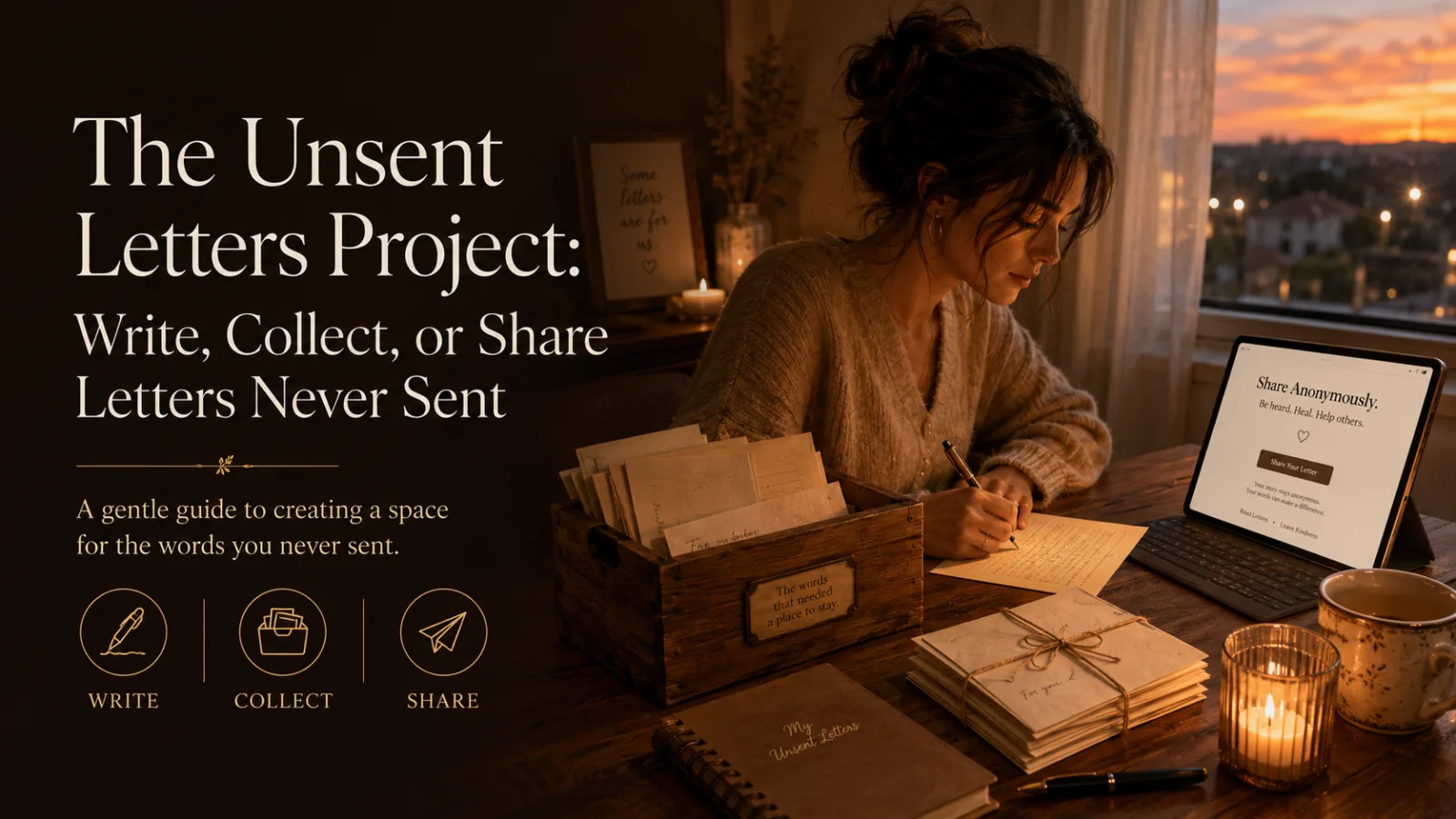
An unsent letters project is a collection of letters written to real people but never delivered.
The project may belong to one person, a classroom, an artist, a grief group, a community, or an anonymous website. The letters may stay private, appear in an exhibition, become part of a book, or live on a public wall where strangers can read them.
The format can change. The central idea stays the same.
People write what they could not say directly.
A private project may contain five letters written over several years. A public collection may receive thousands of submissions from people writing to exes, parents, friends, children, and people who died.
The strongest projects give those letters a clear reason to exist.
What is an unsent letters project?
An unsent letters project brings individual letters together around a shared purpose.
That purpose may be personal:
Processing a breakup
Writing to someone who died
Recording things left unsaid
Letting go of old resentment
Apologizing without demanding forgiveness
Writing to an earlier version of yourself
It may also be public:
An anonymous letter wall
A community art project
A school writing activity
A museum installation
A collection built around grief, love, or family
A website where people submit letters never sent
The letters don’t need to sound polished. They need to belong to the project’s purpose.
A project built around first love will feel different from one built around grief. A classroom collection will need different rules than a public anonymous archive. A private notebook requires almost no moderation. A public site requires careful review.
The title may sound similar, but the work changes depending on who can read it.
Why do people start projects around unsent letters?
Because one letter can feel private, but a collection reveals a pattern.
A person may believe their regret is unusual until they read ten letters written by strangers who also waited too long to apologize.
Someone grieving a parent may feel alone until they see another writer describe reaching for the phone after hearing good news.
A person leaving a difficult relationship may recognize their own thinking in a sentence such as:
I kept calling it loyalty because I didn’t want to admit I was afraid to leave.
Collections create recognition.
They show that the details of each life are different while many of the emotions repeat. Love, guilt, anger, grief, relief, and unfinished hope appear in different forms.
That shared recognition is what gives an unsent letter project weight.
A private unsent letters project
The simplest version belongs to one writer.
You choose a notebook, folder, document, or private account and write letters over time.
The recipient may stay the same. Someone grieving a spouse might write every month. A person healing from a breakup may write whenever the urge to contact their ex returns.
The recipients may also change.
A private project might include:
A letter to your mother
A letter to your first love
A letter to a former friend
A letter to your younger self
A letter to the person you were before a loss
A letter to someone you never met
A letter to the future version of yourself
The project becomes a record of what you were carrying at different points in your life.
You may notice that the tone changes.
The first letter to an ex may be angry. The second may be full of questions. Six months later, the writer may sound less interested in what the ex thinks and more aware of what they lost in themselves.
That change is often easier to see on paper than in memory.
How many letters should the project include?
There is no required number.
One meaningful letter is still an unsent letter project if the writing has a clear purpose and the writer gives it real attention.
A personal collection may contain three letters. A classroom project may collect thirty. A public website may grow for years.
Don’t set a large number simply to make the project look serious.
Fifty rushed letters will say less than five honest ones.
The number should follow the purpose. A grief project may continue for years because the relationship remains part of the writer’s life. A breakup project may end when the writer no longer feels the urge to write.
The project should be allowed to finish.
An anonymous community letter project
A public project gives strangers a place to contribute.
The writer submits a letter without using their real name. The project reviews it, removes or rejects identifying details, and publishes it under a category.
The categories may include:
Love
Breakups
Grief
Family
Friendship
Betrayal
Apology
Regret
Forgiveness
Words left unsaid
A public wall works best when the writing has room to breathe.
Some messages are only a sentence:
I still save the seat beside me without thinking.
Others need several paragraphs to explain the history behind the feeling.
Both belong if the project makes space for them.
That wider purpose shaped Unsent Letters Wall. We wanted a place where someone could write more than a short confession to a first love. A widow could write to her husband. An adult child could address an absent parent. A former friend could finally say what the ending never allowed.
Someone who only wants to understand the form can start with what an unsent letter means and why people write one. A public project takes that private act and gives it a shared home.
What makes a public letter project trustworthy?
Clear rules.
Writers need to know what they can submit. Readers need to know the letters are reviewed. The people described in the letters deserve protection too.
A trustworthy project should reject or remove:
Full names
Phone numbers
Email addresses
Home addresses
Social media handles
Threats
Harassment
Private information about children
Medical details that identify someone
Workplace accusations
Revenge posts
Content designed to send readers after another person
Anonymity should protect expression. It should not become a shield for public punishment.
Moderation also improves the writing.
A letter that removes names, insults, and identifying details often becomes more focused. The writer is forced to explain the experience instead of relying on exposure.
Compare:
Everyone should know what Daniel from Mason Street did to me.
with:
You lied to me for months, and I hated how long I kept defending you after I knew the truth.
The second sentence carries more emotional weight. It also belongs on a letter wall.
An unsent letters project for schools
Teachers sometimes use unsent letters as a writing exercise because the format gives students a clear audience.
A student may write to:
A historical figure
A fictional character
A younger version of themselves
A future self
Someone who changed their life
A person connected to a book or lesson
A place they left
An idea they disagree with
The letter format can help students move beyond a standard essay voice.
A student writing about a novel may understand a character more clearly when addressing them directly:
You kept saying you had no choice, but every chapter showed another moment when you chose silence.
The project should still have boundaries.
Students should not be pressured to reveal trauma, family conflict, abuse, grief, or private relationships. They should always have the option to write fictionally or address a public subject.
Public display should also require permission.
A personal letter written for class should not appear on a hallway wall or school website simply because the assignment was completed.
An unsent letters project as art
Artists often use unsent letters because the form combines private emotion with a physical object.
The letters may be:
Handwritten
Typed
Printed on transparent paper
Sealed in envelopes
Hung from strings
Placed in boxes
Projected onto walls
Read aloud anonymously
Sorted by color, recipient, or emotion
The presentation changes how people encounter the writing.
A sealed envelope creates curiosity because the contents remain hidden. A wall of open letters turns private words into a public chorus. A box filled with hundreds of folded pages shows the weight of what people carry without requiring every letter to be read.
The design should support the writing rather than overpower it.
A beautiful installation can attract attention, but the letters are the reason people stay.
A grief-based unsent letters project
Grief projects need more room than a single goodbye.
People continue having things to say after someone dies.
They may write about:
A birthday
A new child
A family argument
A house move
A holiday
An ordinary meal
A dream
A memory that returned unexpectedly
A collection may begin with:
I never got to say goodbye.
Years later, the same writer may begin with:
Your grandson has your laugh, and I wasn’t ready for that.
The project doesn’t have to move toward a final letter.
Some relationships continue in writing. The person is gone, but the bond still changes as the writer’s life changes.
A grief project should never force a tidy ending.
A breakup-based unsent letters project
Breakup projects often begin during the period when the writer wants to contact an ex.
Writing privately can create distance between the urge and the action.
The first letter might say:
I need you to explain why you stopped loving me.
A later letter may say:
I kept asking why you left because I didn’t want to ask why I stayed after I knew you had checked out.
The shift matters.
The project can help the writer see how the questions change over time.
It can also become unhealthy if every letter repeats the same imagined conversation and keeps the writer waiting for a reunion.
A useful breakup project should move somewhere. That may mean clearer boundaries, fewer letters, a final goodbye, or the decision to stop reading old drafts.
An apology letter project
An apology project can help writers face their behavior before asking another person to hear them.
Each letter should answer:
What did I do?
What effect did it have?
What excuse do I keep using?
What would real responsibility require?
Would sending this help the other person or only relieve me?
A private apology can be brutally honest:
I wanted you to forgive me because I was tired of feeling ashamed. I wasn’t thinking about what hearing from me would cost you.
That sentence may never be sent.
It still matters because it removes the false version of the apology.
A public apology project should avoid identifiable details. It should also resist turning confession into performance. The writer should not receive praise simply for admitting harm.
Can an unsent letters project help with closure?
Sometimes, but closure is a poor promise for any writing project.
A person may finish a letter and still miss the recipient.
They may understand what happened and still wish it had ended differently.
The project can help someone give shape to an unfinished experience. It can show patterns, expose hidden expectations, and record how feelings change.
It cannot guarantee peace.
The strongest projects don’t pressure writers to claim they have moved on. They give them a place to tell the truth at the stage they are in.
Should the letters be shared publicly?
Only if the writer understands what public means.
A public letter can be read by strangers. It can be copied, discussed, screenshotted, or recognized.
The writer should ask:
Could this identify me or someone else?
Would I still post it if the recipient found it?
Those two questions catch most problems.
A writer who needs privacy can still complete the project without publishing anything. The letters may stay in a notebook, password-protected file, sealed box, or private account.
Public visibility isn’t proof that the project mattered.
How to create your own unsent letters project
Start by choosing the purpose.
Don’t begin with a design, logo, or target number. Decide why the letters are being collected.
A clear purpose might be:
Letters to people we lost
Words we never said to our parents
Messages to former versions of ourselves
Letters after friendship breakups
Apologies we may never send
What we wish our first love knew
Letters written during no contact
Then decide who can participate.
A private project needs almost no rules. A small group needs consent and confidentiality. A public project needs submission guidelines, moderation, privacy controls, and a process for removal requests.
Choose the format after those decisions.
What should the submission prompt say?
The prompt should be open enough to invite honesty and narrow enough to give direction.
Good prompts include:
Write to the person you still think about but no longer contact.
Say what you wish you had said before the relationship ended.
Write to someone who died and tell them what happened this year.
Address the person who hurt you without naming them.
Write the apology you owe, even if sending it would be inappropriate.
Tell your younger self what no one told you then.
Avoid prompts that pressure the writer to forgive, heal, confess trauma, or reveal private information.
“Write the letter that will finally set you free” makes a promise the project cannot keep.
“Write what you never got to say” is enough.
Should the letters be edited?
Light editing may be necessary for public projects.
The editor may correct obvious formatting problems, remove names, or contact the writer about identifying information.
The emotional voice should remain intact.
Don’t polish every letter until all submissions sound like the same person wrote them. A short, awkward sentence may be more believable than a perfectly balanced paragraph.
Writers should know in advance whether edits are possible and what kind of changes may be made.
Private projects don’t need editing unless the writer wants to revise later.
How should the letters be organized?
Use categories that readers understand immediately.
A large public project may sort letters by:
Recipient
Emotion
Relationship
Date
Length
Popularity
Newest submissions
Too many categories create confusion.
“Ex,” “First Love,” “Former Partner,” “Breakup,” and “Past Relationship” may overlap enough that writers won’t know where to post.
A cleaner structure might use “Love and Breakups” as the main category, then allow smaller labels beneath it.
The organization should help people find letters without forcing every story into a perfect box.
Why some projects fail
Many unsent letter projects begin with an attractive idea and no plan for what happens after the first submissions arrive.
Common problems include:
No moderation
Duplicate categories
Weak privacy rules
Prompts that are too vague
Letters published with real names
No deletion process
A design that hides the writing
Too much emphasis on social sharing
Treating every submission as safe to publish
Abandoning the project after launch
A public collection needs ongoing care.
People may submit threats, accusations, personal information, copyrighted writing, spam, and content involving minors. Someone has to review it.
The project also needs enough structure that readers can find the letters they came to read.
How Unsent Letters Wall approaches the idea
Unsent Letters Wall was built as a moderated public collection rather than a loose submission form.
Writers can address many kinds of recipients, choose a category, and write a full letter. The wall is meant for love, grief, family, friendship, regret, apology, betrayal, and the words people still carry.
The goal is to make room for the letter itself.
A writer shouldn’t have to reduce a complicated relationship to one clever line. They also shouldn’t need a public profile or a large audience.
The letter can stand on its own.
Readers who are deciding whether public sharing is right for them can read how to post an unsent letter anonymously without exposing private details before submitting anything.
The project can stay small
A meaningful unsent letters project doesn’t need millions of submissions.
It may be ten letters in a box.
It may be one classroom display.
It may be a private document opened only on difficult nights.
It may be a growing public wall read by strangers who recognize themselves in one another’s words.
The size changes the project’s reach. It doesn’t decide its value.
What matters is whether the letters are given enough care, privacy, and space to say what they were written to say.