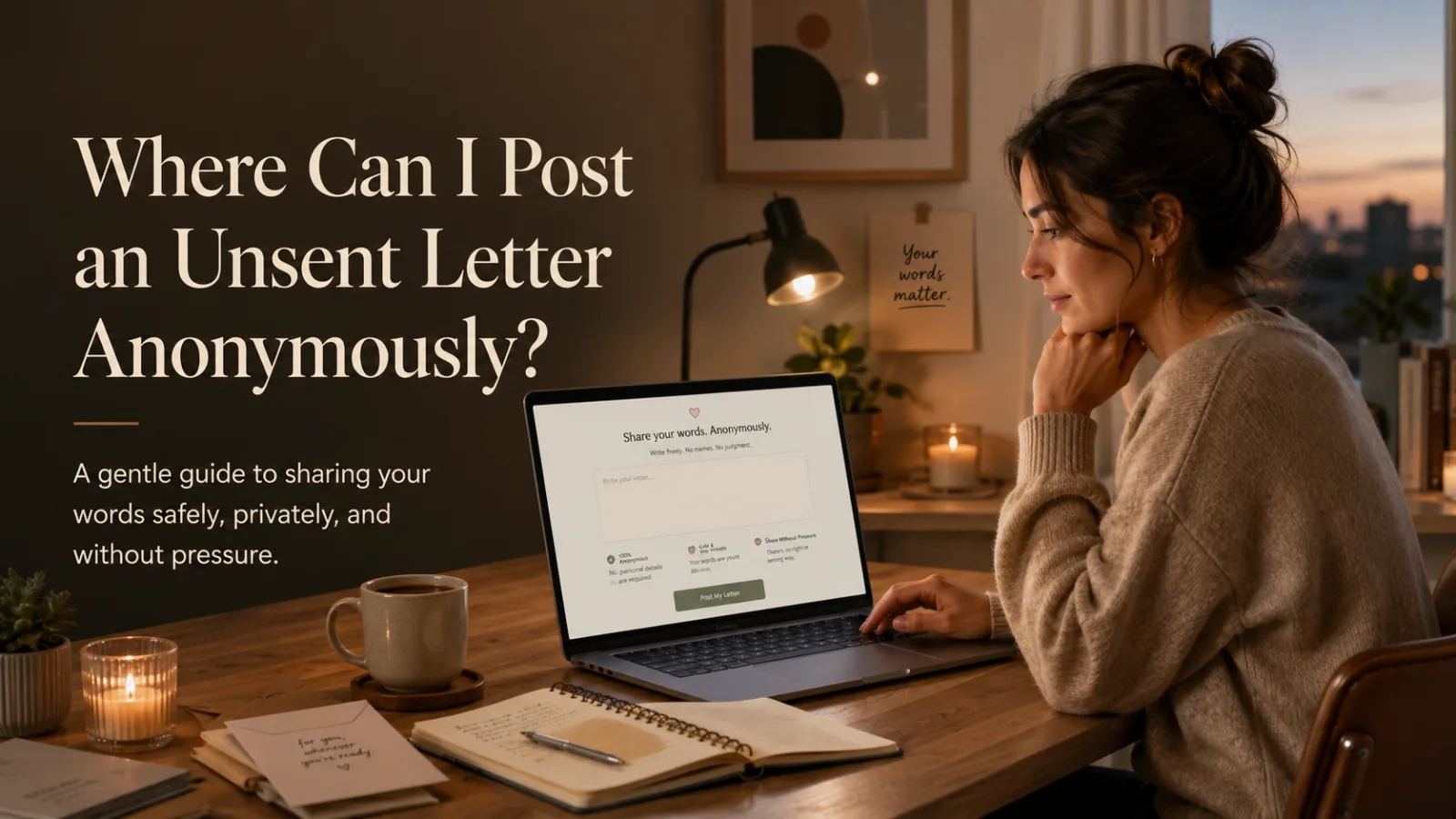
You can post an unsent letter anonymously on a moderated letter-sharing website that allows people to publish personal writing without using their real names.
The right place should let you write freely, choose a category, remove identifying details, and submit the letter for review before it appears publicly. It should also explain what gets rejected and how readers can report content that crosses a line.
That matters because anonymous doesn’t mean consequence-free.
A letter may feel private while you’re writing it, but once it appears online, other people can read it, share it, copy it, or recognize the situation. The goal is to protect the writer’s identity without turning another person’s private life into public material.
Why post an unsent letter online?
Some words feel too heavy to keep and too risky to send.
A person may want to write to an ex who asked for no contact. Someone may have a message for a parent who died years ago. A friend may want to explain a betrayal without reopening the argument. Another writer may still love someone who has moved on.
In each case, direct delivery could create more harm than relief.
Posting the letter anonymously gives the experience a witness. The recipient doesn’t have to receive it, but the writer no longer has to keep every sentence hidden.
That can be especially meaningful after a breakup or death. People often carry ordinary details that have nowhere to go:
I still reach for my phone when something happens at work because you were the first person I used to tell.
Or:
Your birthday came again. I made the cake you liked, even though no one else in the family eats it.
These aren’t always messages that should be sent. They still deserve a place to exist.
What kind of unsent letters can you share?
Most anonymous letter collections include far more than romantic confessions.
People write:
Letters to former partners
Goodbye letters
Apologies
Letters to someone who died
Messages to estranged parents
Letters to children
Notes to former friends
Letters about betrayal
Words for someone they still miss
Things they never had the courage to say
Letters to an earlier version of themselves
An unsent love letter may be tender and restrained. A letter to someone who caused harm may be furious. A grief letter may move between memories, anger, and ordinary updates.
The tone doesn’t need to be polished. It does need to respect the privacy and safety of the people involved.
Should you post the whole letter?
Usually, no.
A private draft can contain names, locations, dates, screenshots, family details, workplace information, and memories that would identify the people involved. Those details may feel necessary while writing because they make the experience real.
Public sharing requires a second pass.
Keep the emotional truth. Remove the clues.
For example, this version reveals too much:
Michael, I still think about the night we fought outside Keller High School after your shift at the restaurant on Main Street.
A safer version keeps the point:
I still think about the night we fought outside my old school after your shift.
The loss remains clear. The identifying trail is gone.
What should you remove before posting?
Start with full names.
That includes the recipient’s name, your own name, children’s names, coworkers, relatives, teachers, doctors, and anyone else connected to the story.
Then remove or change:
Usernames and social media handles
Email addresses
Phone numbers
Street names
Schools
Workplaces
Hospitals or clinics
Exact dates
Small towns
Court details
License plates
Photos
Screenshots
Private medical information
Details about children
Rare events that would make the person easy to identify
A city with millions of people may be less revealing than a small town, but location details are rarely necessary. “The coffee shop near your apartment” usually carries the same emotional meaning as the real business name.
Can the person still recognize the letter?
Yes.
Even without names, a recipient may recognize a shared phrase, private joke, unusual event, or sequence of details.
That possibility can’t be removed completely.
Before posting, read the letter as though you were the other person. Notice which details would make them certain the letter is about them. Then decide whether that recognition would create risk.
The concern isn’t only embarrassment. A recognizable letter could lead to retaliation, renewed contact, family conflict, workplace trouble, or unwanted attention.
If the situation involves abuse, stalking, threats, custody disputes, court proceedings, or someone who has already violated your privacy, publishing the letter may be a poor choice. Keep it private or share it only with someone you trust.
Is anonymous posting really anonymous?
It depends on the website and on what you include.
Using a nickname instead of your legal name helps, but the writing itself can identify you. A letter that names a specific event, relationship, city, and time period may reveal more than a profile ever could.
You should also assume that anything public can be copied.
Deleting a post later may remove it from the original site, but it won’t remove screenshots, search results, shared links, or copies saved by readers.
True anonymity requires restraint. Share the part that needs to be heard without publishing every detail you know.
What makes a good anonymous letter website?
A trustworthy site should explain how submissions are reviewed.
Look for clear rules covering:
Personal information
Threats
Harassment
Hate speech
Sexual content
Minors
Graphic details
False accusations
Copyrighted material
Reporting and removal requests
Moderation protects writers as much as readers. A site that publishes everything automatically may allow names, threats, revenge posts, or deeply identifying claims to remain visible.
The best anonymous letter sites treat the writing as personal expression rather than a tool for public confrontation.
Is an unsent letter the same as an anonymous message?
They overlap, but they aren’t always the same.
A message unsent may be a single line typed into a phone:
I wish I could tell you I finally understand why you left.
An unsent letter usually gives the thought more room:
I spent a long time believing you left because I wasn’t enough. I can see now that we were both asking the relationship to carry things neither of us knew how to face.
Both forms can be shared anonymously. The difference is mostly length, pace, and detail.
For a closer look at shorter texts, notes, and DMs, read What are unsent messages?.
Should you use your real name?
There is usually no reason to use it.
A first name may feel harmless, but even a common name can become identifying when combined with a city, job, age, and relationship history.
Use a pen name, initials, or no name at all.
The same rule applies to the recipient. Writing “Dear J.” may feel private, but the letter may contain enough details that the initial adds one more clue. “To the person I still think about” often works better.
The letter should stand on its own without a legal name attached to it.
Should you tell the recipient you posted it?
Usually, no.
Posting anonymously is meant to avoid direct contact. Sending the person a link defeats much of that purpose.
It can also feel manipulative. The writer may call it anonymous while still hoping the recipient recognizes the story, reads the comments, and responds.
If you need the person to see the letter, you’re no longer making a purely anonymous submission. You’re making a decision about contact.
That decision deserves more care than clicking publish.
Can you post a letter written in anger?
Yes, but don’t post the first draft immediately.
Angry writing often contains the sharpest details, the broadest accusations, and the greatest urge to punish. A sentence written during the emotional peak may feel justified and embarrassing by morning.
Write the raw version privately.
Then return to it later and remove:
Threats
Insults about appearance, race, health, or family
Claims you can’t support
Details meant to humiliate
Private sexual information
Identifying facts
Language designed to send readers after the person
You can still say:
You lied to me for months, and I’m angry that I trusted you.
You don’t need to publish their employer, photograph, and full history to make the hurt believable.
Can anonymous letters include accusations?
They can describe what the writer experienced, but public accusations require care.
A letter may say:
You controlled who I spoke to and checked my phone every night.
That is a first-person account.
Naming the person and presenting serious allegations as established public fact creates a different problem. It may expose the writer and the site to legal complaints, especially when the person can be identified.
Focus on your experience, your reaction, and the effect the events had on you. Remove details that turn a personal letter into a public campaign against someone.
What if the letter is about someone who died?
Letters to people who died often contain names, dates, medical details, family stories, and funeral information.
Some writers feel comfortable sharing those details. Others later regret exposing private grief or information about surviving relatives.
You can protect the intimacy of the story without making it vague.
Instead of naming the hospital, diagnosis, and exact day, you might write:
I knew the last visit was probably goodbye, but I still talked about next summer as though we had one.
That sentence carries the loss without publishing the person’s medical history.
What if the letter is to an ex?
Breakup letters are among the easiest to recognize.
Shared trips, nicknames, songs, restaurants, anniversaries, and descriptions of the breakup may reveal both people quickly.
The temptation is to preserve every detail because those details are what made the relationship yours. Keep the ones that carry emotional weight and change the rest.
A line such as:
I still avoid the little Italian restaurant where we had our first date.
can become:
I still avoid the place where we had our first date.
The memory remains intact. The restaurant stays out of it.
Will people judge the letter?
Some readers will.
Anonymous sharing opens the writing to strangers, and strangers won’t always interpret the situation the way the writer intended. They may sympathize with the recipient. They may misunderstand the tone. They may bring their own experiences into the comments.
Don’t post because you need universal agreement.
Post because you’ve decided the words can exist publicly even if readers react in ways you can’t control.
A moderated wall should remove harassment and cruelty, but it can’t guarantee that every reader will see the story exactly as you do.
What should you expect after submitting?
A moderated site may review the letter before publication.
It may be edited, delayed, or rejected if it contains names, contact details, threats, accusations, explicit content, or information that could harm someone.
Approval doesn’t mean the site is declaring every claim true. It means the submission fits the rules for personal expression.
Once published, the letter may receive views, reactions, or shares. It may also receive little attention. Public visibility shouldn’t be the measure of whether the letter mattered.
The act of posting and the response to the post are separate experiences.
Can you edit an anonymous letter later?
That depends on the platform.
Some sites allow writers to create an account and edit their submissions. Others accept letters without an account, which may make later changes difficult.
Before publishing, check whether the site offers:
Editing
Deletion
Reporting
Removal requests
Private drafts
Comment controls
Account-based submissions
Anonymous submissions without registration
If there is no editing option, review every line carefully before submitting.
Should you post anonymously or keep the letter private?
Keep it private if publishing could put you or someone else at risk.
Share it anonymously if you want the words witnessed, understand that they may be copied, and can remove enough detail to protect everyone involved.
You can also wait.
A letter doesn’t expire because it sat in a private file for a month. Distance often makes it easier to see which parts belong in public and which parts were meant only for the writer.
If you’re still deciding what the letter means or whether it should remain private, read What is an unsent letter?.
How to prepare an unsent letter for anonymous posting
Write the first version without thinking about publication.
Say what happened. Include the real names if that helps you write honestly. Describe the places, dates, and memories as you remember them.
Then save it and step away.
When you return, make a public version. Remove names. Change locations. Blur timelines. Cut details about children, health, work, and legal matters. Delete any sentence written mainly to shame the recipient.
Read it once more and ask two questions:
Could this letter identify me or someone else?
Am I comfortable with a stranger saving or sharing it?
If either answer concerns you, keep editing or don’t publish it.
The public version can still be direct:
I loved you longer than I admitted, even after the relationship became something I had to recover from.
The sentence says what matters. It doesn’t tell strangers who the recipient is.
Where can you share your unsent letter?
Unsent Letters Wall was created for people who need somewhere to place the words they won’t send directly.
Writers can submit letters about love, grief, regret, betrayal, family, friendship, apology, and everything left unsaid. You don’t need to use your real name, and the person you’re writing to doesn’t need to know the letter exists.
Before submitting, remove identifying information and read the community rules carefully.
Then write the version you’re willing to let others witness.